
Can AI Help Reduce Clinical Errors?
How AI Co-Pilots Are Quietly Preventing Medical Mistakes, One Clinic at a Time

A medical error is a preventable failure in the diagnostic, treatment, or procedural process that can harm patients, even if not immediately apparent. Globally, about 1 in 10 patients suffers harm during healthcare, with over 3 million deaths each year resulting from unsafe care (World Health Organization). In the U.S., estimates suggest up to 250,000 preventable deaths annually from medical mistakes, a sobering reminder that medical errors can be the third leading cause of death (Association of Health Care Journalists).
Errors often fall into three categories:
Diagnostic: misdiagnosis or delayed diagnosis
Treatment: incorrect drug or dosage
Procedural: mistakes during surgery or instrument errors
Such errors not only cause avoidable harm to patients, but impose trillions of dollars in global healthcare costs and lost productivity.
How AI Is Stepping In
Recent advances in AI, especially large-language models (LLMs) and Clinical Decision Support Systems (CDSS), offer a new layer of protection:
Information synthesis: LLMs can quickly consolidate relevant patient data, guidelines, lab results, and medical literature to aid decision-making (PMC, Nature).
Real-time alerts: AI that silently monitors care decisions and prompts clinicians only when necessary (a “clinical co-pilot”) has the dual benefit of reducing mistakes without disrupting workflow (TIME).
Learning & feedback loops: Interactive AI feedback helps clinicians learn and avoid repeating errors over time (TIME, OpenAI).
In other domains of medicine, AI has been successfully tested for:
Medication safety checks, identifying prescribing errors with high accuracy in complex scenarios (arXiv).
Documentation and transcription, where AI tools reduce errors introduced during note-taking (arXiv).
Cognitive bias mitigation, using multi-agent LLM setups to challenge diagnostic assumptions and broaden perspectives (arXiv).
The Penda Health & OpenAI Study at a Glance
The most compelling recent data comes from the AI Consult initiative, a collaboration between OpenAI and Nairobi-based Penda Health:
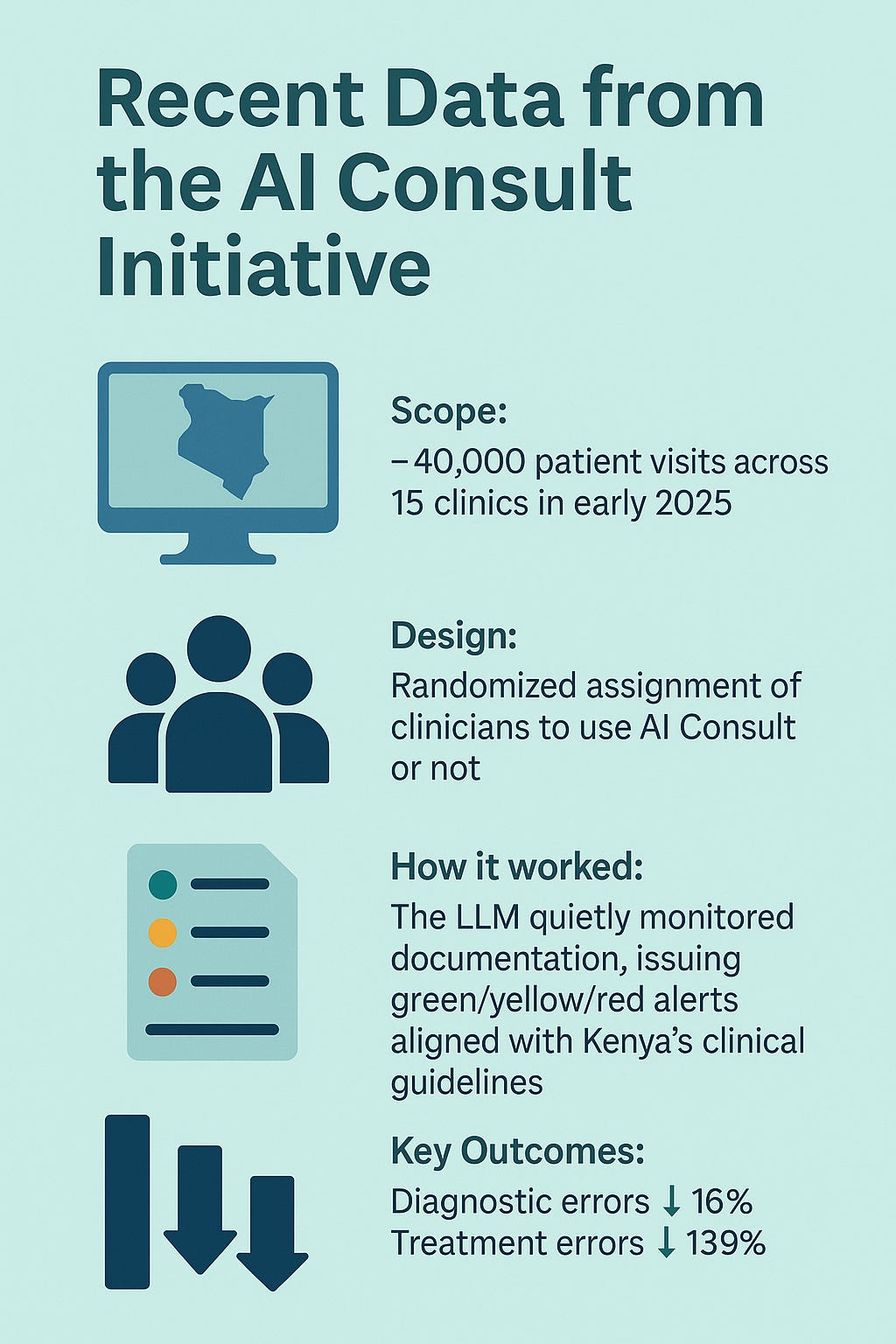
Scope: ~ 40,000 patient visits across 15 clinics in early 2025.
Design: Randomized assignment of clinicians to use AI Consult or not (OpenAI).
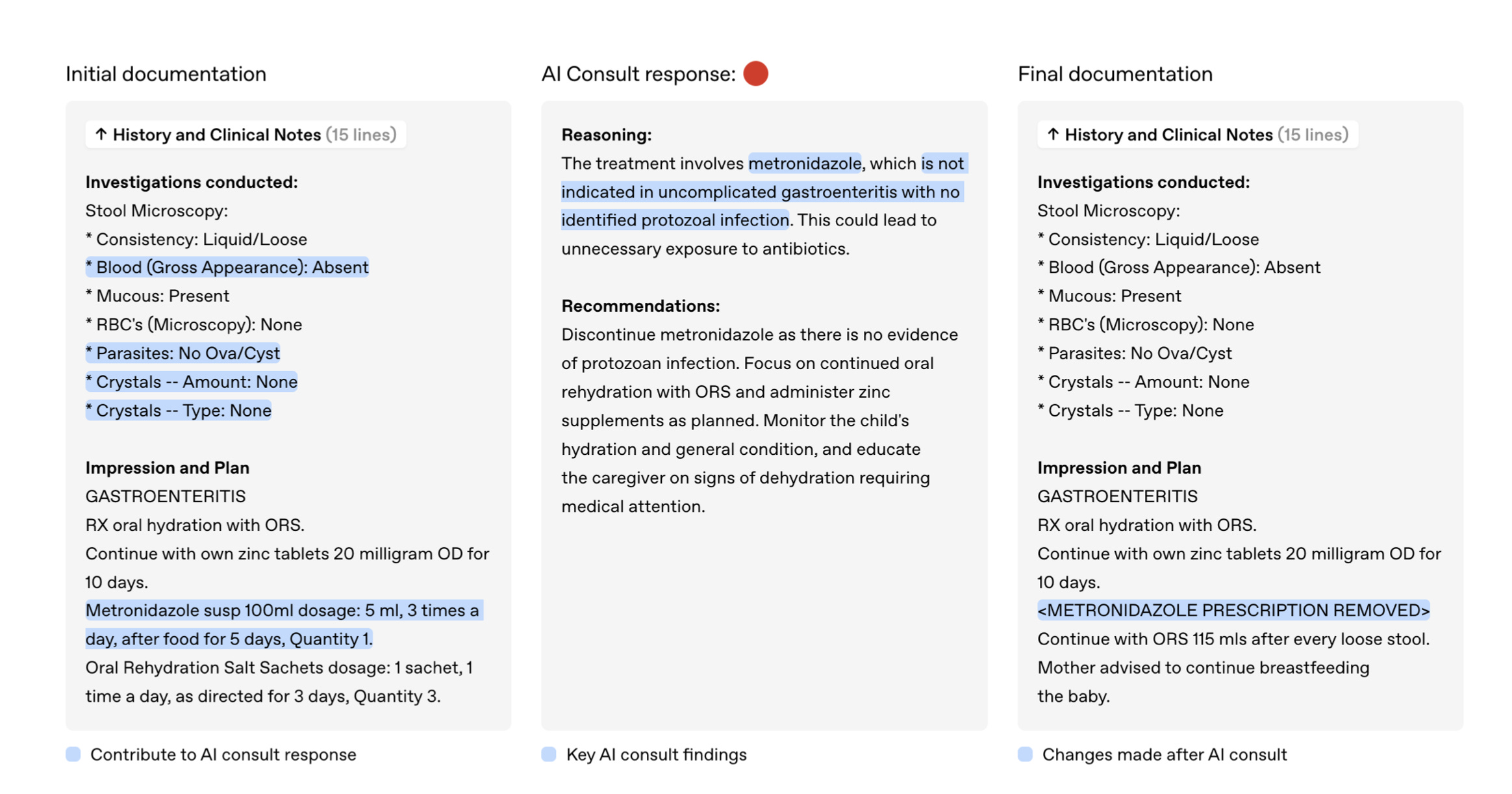
How it worked: The LLM quietly monitored documentation, issuing green/yellow/red alerts aligned with Kenya’s clinical guidelines (TIME, OpenAI).
Key Outcomes:
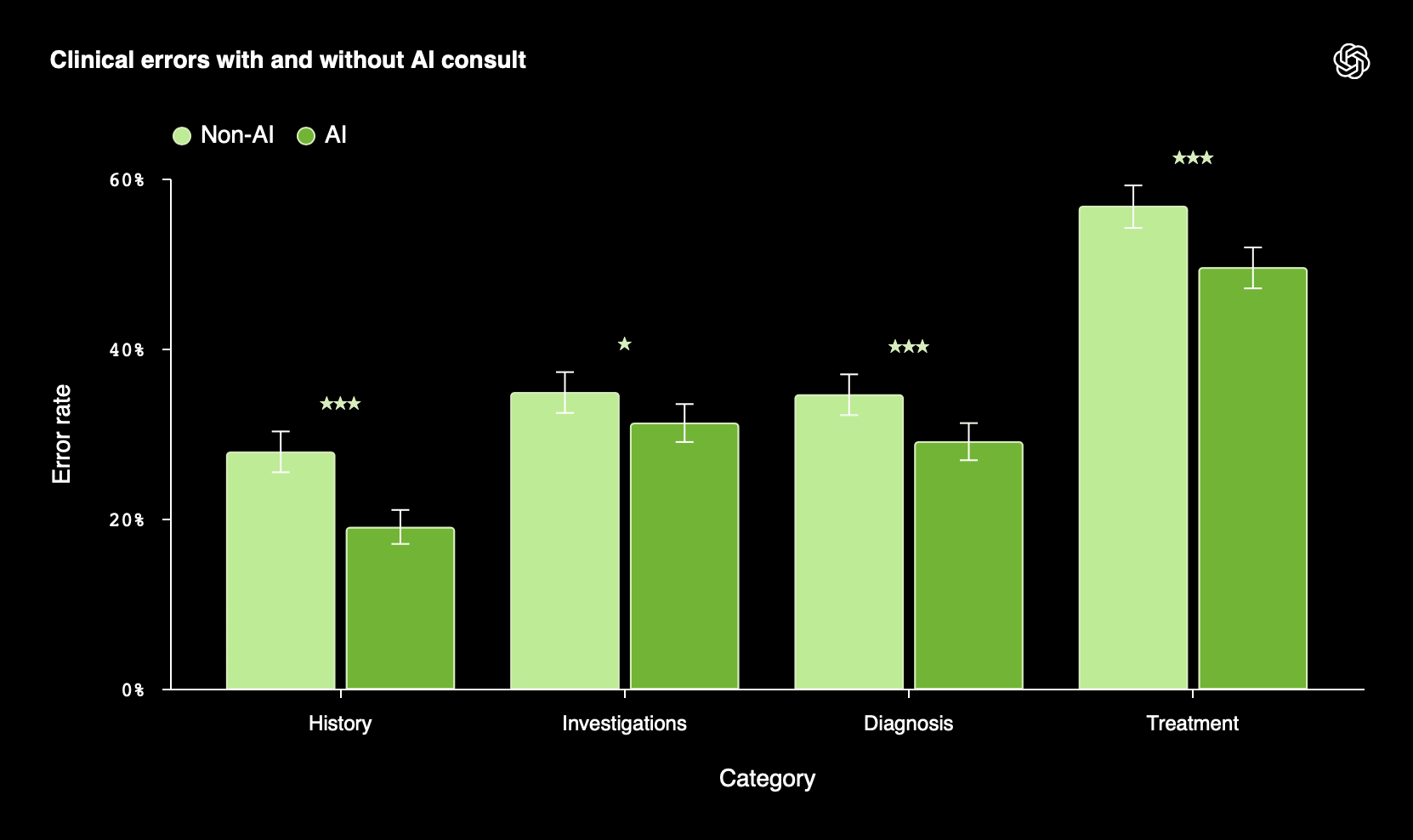
Diagnostic errors ⬇️ 16%
Treatment errors ⬇️ 13% (TIME)
Among cases flagged “red,” diagnostic errors dropped 31% and treatment errors 18% (OpenAI, TIME)
Unexpected Benefits:
Clinicians reported that AI Consult functioned as a teaching mentor, building confidence and reinforcing knowledge (TIME).
The reduction in red alerts over time—from 45% to 35%—suggests an ongoing learning effect (OpenAI, TIME).
This study stands out because it's one of the first real-world, prospective trials showing that LLMs can tangibly reduce clinical errors during active patient care, not just in simulations (OpenAI).
Broader Evidence & Emerging Tools
Medication Safety CDSS: LLM-based systems, especially when integrated into retrieval-augmented frameworks, outperform traditional models in identifying serious drug errors (arXiv).
Hallucination detection frameworks: Tools like CHECK have slashed “hallucination” rates to under 0.3%, critical for maintaining clinical trust (arXiv).
Multi-agent LLM reasoning: Simulated “team conversations” among AI agents increased diagnostic accuracy up to 80% in tricky clinical cases (arXiv).
Perioperative support: The PEACH AI chatbot achieved nearly 98% accuracy in pre-op decision-making, with few hallucinations (arXiv).
These tools don't replace clinicians; they serve as co-pilots, augmenting human performance and resilience.
Challenges Ahead
Despite clear promise, hurdles remain:
Automation bias: Clinicians might over-rely on AI prompts and override correct judgment (TIME).
Workflow integration: LLM systems must mesh with varying health record systems and clinical environments (Wikipedia).
Trust & reliability: Even low hallucination rates are unacceptable in life-or-death medicine—robust monitoring and validation are essential (arXiv).
Looking Ahead: Toward Safer, Smarter Care
AI-driven solutions like AI Consult offer a glimpse into a future where avoidable mistakes are caught before they reach patients, where every clinician—novice or expert—operates with a digital safety net.
To advance this vision, we need:
More real-world, prospective trials (like Penda’s study), ideally across diverse settings and care levels.
Multi-modal AI tools that combine text, imaging, lab data for holistic decision support.
Training programs to help clinicians use AI tools effectively, avoiding pitfalls like over-trust or misapplication.
The evidence today shows a clear signal: AI, thoughtfully deployed, can reduce diagnostic errors by ~16% and treatment errors by ~13%. But the real milestone is what comes next—scaling that impact, tailoring AI to complex health ecosystems, and keeping clinicians in the driver’s seat.
Conclusion: Co-Pilots, Not Replacements
AI in healthcare isn’t about replacement—it’s about augmentation. Tools like AI Consult offer timely, targeted feedback that helps clinicians avoid errors, learn continuously, and deliver safer care. As more evidence accumulates and integration improves, AI co-pilots will likely become a standard part of clinical workflows—helping every patient receive the accurate, timely care they deserve.